

動態
JUSTLEE Insights
The debate rarely gets a straight answer. Most conversations about colored gemstones versus diamonds stay at the surface — personal taste, occasion, aesthetics. The more important questions go unasked: what actually drives value in each market? Where does rarity come from, and how is it priced?
These aren't academic questions. They're what determines whether a purchase holds its value over decades.
At JUSTLEE, we've been selecting gemstones for over fifty years. Here's how we think about both markets.
Why Diamonds Have a Price List and Unheated Colored Gemstones Don't
The Rapaport Diamond Report publishes weekly wholesale reference prices — a standardized grid built on carat weight, color (D through Z), clarity (FL through I3), and cut. For any GIA-certified 1-carat D/VS1 round brilliant, two dealers in different cities should arrive at comparable figures. That transparency serves buyers well. It also caps upside: when anyone can look up a price in seconds, there's limited room for knowledge to create premium.
Colored gemstones don't work that way. There's no Rapaport equivalent, and there couldn't be. Consider two rubies, both labeled Burmese: one carries a GRS Pigeon Blood designation from Mogok with no indications of heating; the other has undisclosed origin and has been heat-treated. The per-carat difference at the top of the market easily exceeds tenfold. No weekly report bridges that gap — because the gap isn't about grade, it's about knowledge.
That's the structural difference between these two markets. It's why buying colored gemstones well requires more expertise — and why, for those who have it, the potential upside is harder for market efficiency to compress.
Diamonds vs. Collector-Grade Unheated Gemstones — A Structural Comparison
| White Diamond | Collector-Grade Unheated Gemstone | |
| Chemical Structure | Pure carbon crystal; cut determines optical performance | Varied minerals — corundum (ruby, sapphire), beryl (emerald); trace elements determine color, geology determines quality |
| Pricing System | Rapaport benchmark, globally transparent; comparable grades yield consistent quotes | No public benchmark; value assessed individually across more variables than any table captures |
| Certification | GIA (4C framework: color, clarity, carat, cut) | GRS · Gübelin · SSEF and internationally recognized gem laboratories (origin determination, treatment status, color grade) |
| Replicability | High; lab-grown diamonds now match natural quality at falling cost | Low; specific geological conditions and mine origin cannot be reproduced |
| Mine Status | Multiple active mines worldwide; lab-grown supply expanding | Kashmir deposits near-exhausted since the 1880s; Argyle closed permanently in 2020; top Mogok material declining year on year |
| Knowledge Barrier | Relatively standardized; Rapaport provides an accessible entry point | High; requires judgment across origin, treatment status, and the specific authority of different labs |
Compiled by JUSTLEE Consultant Team
What Happens to Prices When a Mine Closes — From Argyle Pink Diamonds to Unheated Kashmir Sapphires
When Rio Tinto shut down the Argyle mine in Western Australia in November 2020, it ended the supply era for pink diamonds. At its peak, Argyle produced over 90% of the world's pink diamond output. Once it closed, existing inventory became fixed. Every pink diamond that changes hands now is one that already existed — there's no new material entering the market. That's not a marketing position. It's geology.
Auction records since the closure show exactly what markets do when finite supply meets sustained demand: top Argyle pink diamond prices per carat have climbed steadily in the years following, a direct repricing of inventory that can no longer be replenished.
Kashmir sapphires have operated under the same logic for far longer. The primary deposits were essentially exhausted in the 1880s — a mining window of less than a decade. More than a century of exploration since has turned up nothing commercially viable. Mogok ruby follows a similar trajectory: the volume of top-grade unheated material entering the market each year is measurably less than the year before. Colombian Muzo emeralds, the source of the vivid Muzo Green saturation that defines the finest examples, face the same steady supply compression.
The common thread across all of these origins: rarity is a geological fact, not a managed narrative. Every top-grade colored gemstone with certified provenance represents a physical record the earth will not produce again.
Read more: Why Kashmir Sapphires Keep Getting Harder to Find
What Auction Records Reveal: The Per-Carat Pricing Logic of Collector-Grade Unheated Gemstones
Auction results are as close as this market gets to objective pricing — what an informed buyer, in open competition, is genuinely willing to pay for a specific stone.
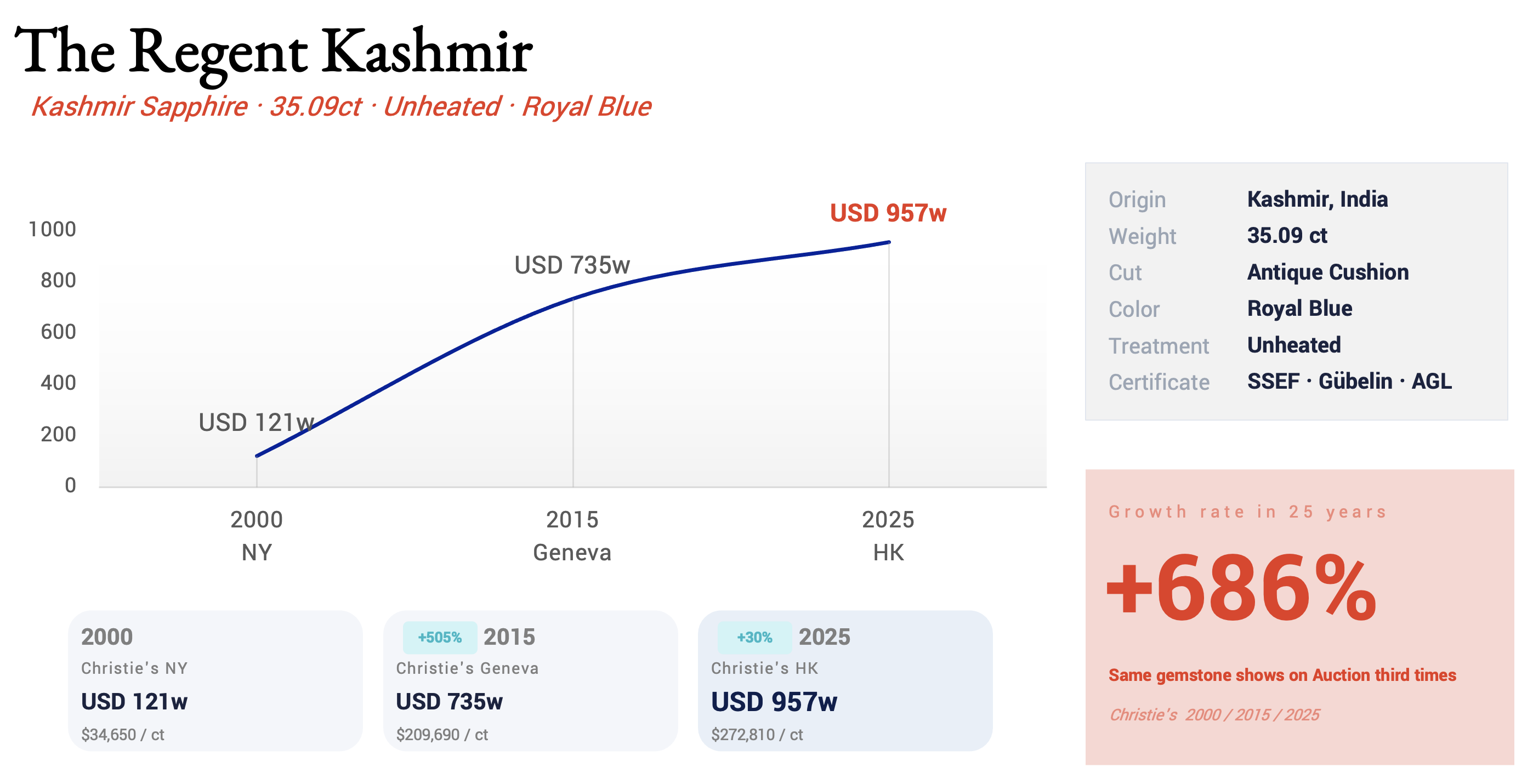
The per-carat history of Kashmir sapphires tells a particularly clear story. In May 2015, The Regent Kashmir — a 35.09-carat unheated Kashmir sapphire — sold at Christie's Geneva for USD 209,689 per carat (Lot 351). Five months later, the 27.6-carat Jewel of Kashmir sold at Sotheby's Hong Kong for USD 243,703 per carat, taking the record.
A decade later, The Regent Kashmir returned to the room. On 27 May 2025, at Christie's Hong Kong Magnificent Jewels (Lot 1930), the same stone sold for HKD 74.765 million — approximately USD 9.57 million, or USD 271,515 per carat. A new world record for a sapphire at auction, measured per carat. SSEF and Gübelin both issued 2025 reports certifying the color as Royal Blue, the highest classification, and confirming no indications of heating. Between its 2015 and 2025 Christie's appearances, the per-carat value rose approximately 29.5% — against a backdrop of zero new Kashmir supply.
Three conditions produced that number: unheated status, Kashmir origin, and concurrent certification from two of the world's leading gem labs. Remove any one of them, and the valuation changes materially. That's the market telling you precisely what it values — and why selection judgment carries decisive weight in a market with no price list.
JUSTLEE — Fifty Years of Unheated Colored Gemstones
We're not here to argue that colored gemstones beat diamonds. They don't — as a category. What we are confident in: within the colored gemstone market, there's a specific tier where the value logic becomes unusually clear. Natural and untreated, top-tier mine origin, certification from internationally recognized laboratories, Auction-grade rarity. When a stone meets all four, its rarity is grounded in physical fact. Its value doesn't depend on trend.
That's the standard we've applied for fifty years, and the basis on which we advise every collector we work with. Top-grade colored gemstones take real knowledge to read correctly. JUSTLEE exists to help you build it.
Read more: Fifty Years of Curation: The Four Standards JUSTLEE Has Never Compromised
References
- Christie's Magnificent Jewels, Hong Kong, 27 May 2025, Lot 1930 (christies.com)
- Christie's Magnificent Jewels, Geneva, 13 May 2015, Lot 351 (christies.com)
- Sotheby's Magnificent Jewels, Hong Kong, October 2015 (sothebys.com)
- Rapaport Diamond Report — pricing methodology (rapaport.com)
- GRS Gem Research Swisslab (gemresearch.ch)
- Gübelin Gem Lab (gubelingemlab.com)
- SSEF Swiss Gemmological Institute (ssef.ch)
FAQ
Q: Colored gemstones or diamonds — which should I collect?
A: They operate on different logic, and the better question is which logic suits you. Diamonds offer a transparent, standardized pricing system through Rapaport — the rules are publicly available and consistently applied. Top-grade unheated colored gemstones have no equivalent benchmark; value is determined by origin, treatment status, certification, and color grade, which takes more expertise to navigate. The trade-off: when you know what you're looking at, the ceiling is structurally higher than the diamond market allows. Neither is better. They're different asset types.
Q: Why don't colored gemstones have a price list the way diamonds do?
A: Because diamonds can be meaningfully standardized — a 1-carat D/VS1 round brilliant is genuinely comparable to another one. Colored gemstones resist that. Two rubies with identical carat weight can differ in value by tenfold based on origin and treatment status alone. Layer in the fact that different labs carry different authority depending on the stone type, and any attempt at a unified pricing grid breaks down. The market stays inefficient by nature — which is exactly why knowledge matters so much in it.
Q: Do top unheated colored gemstones actually outperform diamonds per carat at auction?
A: Under the right conditions, yes. Top-grade unheated Mogok Pigeon Blood rubies and Kashmir sapphires have consistently exceeded equivalent white diamonds on a per-carat basis at major international auction. The same shift has happened with Argyle pink diamonds since the mine closed in 2020 — their pricing now behaves more like fine colored stones than white diamonds. The qualification that matters: these figures reflect a very narrow top tier — unheated, top mine origin, certified by recognized laboratories. That standard doesn't apply broadly.
Q: What does "unheated" actually mean, and how much does it affect price?
A: An unheated gemstone hasn't been subjected to artificial heat treatment — it's in the condition the earth produced it. Lab reports note this as "no indications of heating." Heat treatment is standard practice across the trade; it improves color and clarity, it's not misrepresentation, but it's permanent. More than 90% of commercial rubies and sapphires have been treated. Among stones that reach top color and quality grades without any treatment, the per-carat premium over treated equivalents typically runs three to ten times. For top-tier mine origins, the range is wider.
Q: Can colored gemstones hold or increase in value?
A: The ones that do share a consistent profile: natural and untreated, top-tier mine origin, certified by GRS, Gübelin, or SSEF, and of genuine auction-grade quality. That combination has shown a clear long-term appreciation track across 25 years of major auction records. It doesn't apply to colored gemstones as a category — most don't carry these characteristics. What determines whether a stone has that profile: the selection standard applied, the transparency of its sourcing, and the completeness of its certification.
 Facebook
 Instagram
 Line
Line