

動態
JUSTLEE Insights
A certified Royal Blue sapphire represents the absolute apex of corundum evaluation, defined gemologically by a highly specific vivid blue hue with a subtle violet modifier, optimal saturation, and a medium-dark tone. In May 2025, the global auction market demonstrated the ultimate premium for this combination when "The Regent Kashmir," a 35.09-carat unheated Kashmir sapphire certified by SSEF and Gübelin as Royal Blue, achieved a historic US$ 9.5 million—translating to US$ 271,515 per carat. This benchmark confirms that true asset-grade value relies on three unyielding parameters: an elite color grade, an unheated (No Indications of Heating) status, and a pedigreed origin.
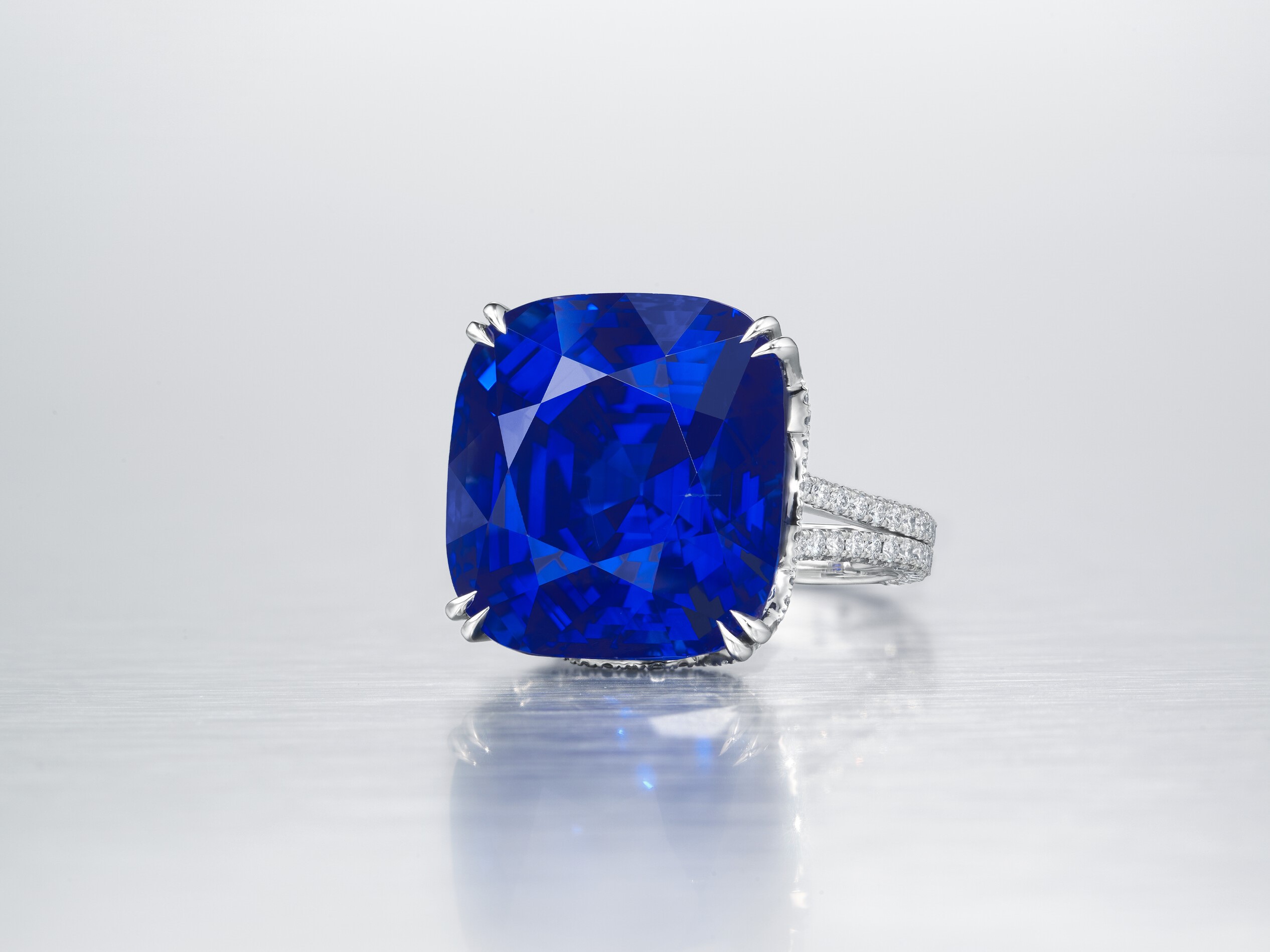
Resource: christies, The Regent Kashimir sapphire and daimond ring
The Anatomy of "Royal Blue": How GRS, Gübelin, and SSEF Quantify the Ideal Hue
To achieve a "Royal Blue" master grade from tier-one laboratories like GRS, Gübelin, or SSEF, a sapphire must withstand a highly quantified colorimetric evaluation. Grading is conducted strictly under standardized artificial daylight (matching the D65 CIE standard) to eliminate any ambient color temperature bias.
The primary hue must be a pure, deep blue. However, the true gemological differentiator is the presence of a subtle violet modifier. This precise secondary hue wavelength is critical: it injects a visual "vibrancy" into the crystal, preventing the stone from falling into "extinction"—a phenomenon where a deep blue sapphire appears overly dark or black under low-light conditions.
Furthermore, the saturation must be exceptionally high (vivid), balanced perfectly with a medium-to-dark tone. If the tone drops too dark, the stone loses its internal brilliance and fire; if it is too light, it is classified merely as an intense blue.
Color Grading vs. Treatment Status: Why They Must Be Evaluated Separately
In the international gemstone market, confusion often arises when buyers treat a color grade as a guarantee of value. A certificate that reads "Royal Blue" only defines the visual appearance of the stone; it does not disclose its underlying rarity. To a serious collector, the critical distinction lies in the treatment status: Heated versus Unheated (No Indications of Heating).
Thermal enhancement (heating) is a routine industrial practice used to artificially deepen color and dissolve internal haziness. While a heated sapphire can achieve a beautiful "Royal Blue" appearance, it is fundamentally a product of human intervention. Conversely, a natural, unheated Royal Blue sapphire is a geological miracle—its color and clarity were finalized under the earth's crust millions of years ago without any artificial modification.
This distinction creates a massive disparity in asset allocation and market value. In the global auction house ecosystem, two sapphires of identical weight and the same "Royal Blue" color grade will command completely different price tiers:
Royal Blue + Heated:
Widely available in commercial luxury channels. It serves as decorative fine jewelry but lacks the scarcity required to command a significant premium at major auction houses.
Royal Blue + Unheated:
Considered an auction-grade asset. Because of its extreme geological rarity, collectors willingly pay a premium of 300% to 500% over its heated counterparts, ensuring robust liquidity and long-term wealth preservation.
The Absolute Rarity of Kashmir: The Benchmark of Velvet Blue
The market value of a Kashmir sapphire has transcended the boundaries of a simple geographic origin; it has become an independent valuation benchmark in the high-jewelry ecosystem. The premium commanded by this origin is backed by clear, quantitative data from recent global auctions.
In the elite collector's market, the pricing trajectory for unheated Royal Blue sapphires reveals a significant tier gap between Kashmir and other premium origins:
May 2024 (Sotheby’s Geneva): An unheated Kashmir Royal Blue sapphire weighing 17.29 carats fetched approximately US$ 3.8 million, which translates to around US$ 219,780 per carat.
May 2025 (Christie’s Hong Kong): The historic sale of "The Regent Kashmir"—a 35.09-carat unheated Kashmir sapphire with dual certification from SSEF and Gübelin (both featuring special Royal Blue appendices)—reached US$ 9.5 million. This set the current world auction record for sapphire at US$ 271,515 per carat.
This exponential price-per-carat premium is directly tied to a historical supply cutoff. The original deposit in the Zanskar Range of the Himalayas was discovered accidentally in 1881 and was intensively mined out within a few decades. By the 1930s, commercial production had effectively ceased.
Consequently, every auction-grade Kashmir sapphire circulating in the market today is a historical artifact from a finite, non-renewable pool. This absolute physical scarcity provides an unshakeable foundation for its continuous capital appreciation.
Auction Record Source:The Value May 2025 Christie's HK Luxury Week Analysis
Origin Impact on Valuation: The Market Gap Between Burma, Ceylon, and Kashmir
While premier gemological laboratories apply unified colorimetric data to award the "Royal Blue" designation regardless of a gemstone's origin, the international auction market operates on a strictly hierarchical valuation system. The geographic coordinate of a sapphire does not change its laboratory color grade, but it fundamentally dictates its market liquidity and price floor.
Compiled by JUSTLEE consultant team from published gemmological research, laboratory standards, and publicly available auction records. For educational reference only; Does not constitute investment advice.
Further Insights from the Archive:
Ruby vs Sapphire: Same Mineral Family - Why the Evaluation Logic Is Completely Different
JUSTLEE curated unheated Sapphire
FAQ
Q: Does a "Royal Blue" grade on a laboratory report automatically guarantee investment value?
A: No. A color grade specifies visual appearance but does not dictate rarity or market liquidity. A true auction-grade sapphire must simultaneously be unheated (No Indications of Heating), possess high internal clarity, exhibit an excellent cut with lively brilliance, and ideally come from a prestigious origin. A Royal Blue sapphire that has undergone thermal enhancement or suffers from heavy internal inclusions will face restricted liquidity and lower long-term asset retention.
Q: What are the primary visual differences between a Burmese Royal Blue and a Ceylon Royal Blue?
A: Burmese Royal Blues are typically characterized by a deeper, more saturated body color, while Ceylon Royal Blues offer higher transparency and a more vibrant, electric brilliance. This variance is caused by the differing trace element ratios within the geology of each mining region. However, tier-one laboratories apply the exact same chromatic boundaries to award the "Royal Blue" designation; the distinct visual personalities are reflected in market valuation premiums rather than the certificate grade itself.
Q: Why do some certificates state "Vivid Blue" while others state "Royal Blue"?
A: "Royal Blue" is a highly selective sub-category within the broader "Vivid Blue" classification. In the GRS grading system, for instance, all Royal Blue sapphires are technically Vivid Blue in terms of saturation, but they must specifically fall within a precise medium-dark tone range and carry a subtle violet modifier. The grading matrix for Cornflower Blue operates on a fundamentally different logic from that of Royal Blue; details will follow in the next insight.
Q: Can You Tell If a Blue Sapphire Is Unheated Just by Looking at It?
No — and that is precisely why laboratory certification matters. Heat treatment is designed to make sapphires more visually appealing, meaning treated and untreated stones can appear nearly identical to the naked eye. Only advanced analysis by institutions such as GRS, Gübelin, or SSEF can confirm whether a stone shows "No Indications of Heating." This is why treatment status on a certificate carries genuine weight in the collector market: it represents a condition that cannot be self-assessed.
Q: Are There Lab-Grown Royal Blue Sapphires, and How Do They Differ from Natural Stones?
Yes. Laboratories can produce synthetic sapphires that are chemically and physically similar to natural ones, including stones engineered to meet Royal Blue color criteria. However, synthetic sapphires are manufactured products with unlimited production capacity and zero inherent scarcity. The collectible value of a natural unheated Royal Blue sapphire rests on the physical irreversibility of its geological formation — a condition no manufacturing process can replicate.
Q: What Certifications Should a Royal Blue Sapphire Have?
The most credible authentication comes from independent reports issued by two or more leading gemological laboratories — such as SSEF, Gübelin, or GRS — each confirming origin, treatment status, and color grade separately. When two institutions both state "Royal Blue" and "No Indications of Heating," the verification carries substantially more weight than a single-lab assessment. The Regent Kashmir, which set the per-carat auction record at Christie's Hong Kong in 2025, held concurrent appendix-level reports from both SSEF and Gübelin — one of the conditions underpinning its record valuation.
The JUSTLEE Perspective: Preserving Wealth Through the Unaltered
In an era dominated by rapid synthetic advancements and aggressive industrial treatments, true luxury is defined by what remains entirely untouched by man. To the serious investor, an unheated Royal Blue sapphire is not merely an acquisition of fine jewelry—it is a finite, portable shield for capital preservation.
At JUSTLEE, our fifty-year heritage is rooted in a single, unyielding principle: we do not compromise on the natural state of a gemstone. By curating exclusively natural, unvaried, and unheated masterworks, we ensure that the pieces you acquire today remain rare, liquid, and secure for generations to come.
Written by: JUSTLEE Consultant Team
 Facebook
 Instagram
 Line
Line