

動態
JUSTLEE Insights
Origin — Why Colombian Green Cannot Be Replicated Elsewhere
Colombian emeralds form within a black shale geological matrix in the Andes — an environment simultaneously rich in chromium and vanadium. Chromium is the primary driver of colour saturation; vanadium deepens tonal range. This combination is rare globally. Zambian emeralds are also chromium-coloured — their host rock is chromium-bearing metabasite — but carry markedly higher iron than Colombian material. Iron suppresses the red fluorescence generated by chromium and vanadium, giving Zambian stones a bluer, deeper colour that lacks the brightness top Colombian emeralds project from within the crystal. Brazilian material lacks the chromium concentration that defines top Colombian colour. At equivalent treatment levels and carat weights, Colombian emeralds command a 30 to 50 percent per-carat premium over Zambian or Brazilian stones — grounded in geology, not provenance branding.
Muzo
Located within the western emerald zone of Colombia's Boyacá department, the Muzo mining region produces emeralds characterised by deep, richly saturated pure green — no blue secondary hue, no yellow shift, colour emanating from within the crystal rather than reflecting at its surface. This colour profile has long served as the trade benchmark for top-grade Colombian emeralds. When GRS introduced its proprietary "Muzo Green" colour designation in 2015, the naming drew directly from this tradition.
Chivor
Situated in the eastern emerald zone, Chivor produces emeralds with a distinctly cooler character — a slight bluish-green cast that differentiates them clearly from Muzo's warmer, purer green. Both origins are recognised by GRS, Gübelin, and SSEF as confirmed Colombian provenance, and both have their place in serious collections. Understanding this distinction matters because Colombian origin alone does not resolve colour: the mine zone shapes the stone's aesthetic direction, and the tonal difference between Muzo and Chivor material is consistent enough to be meaningful at the point of evaluation.
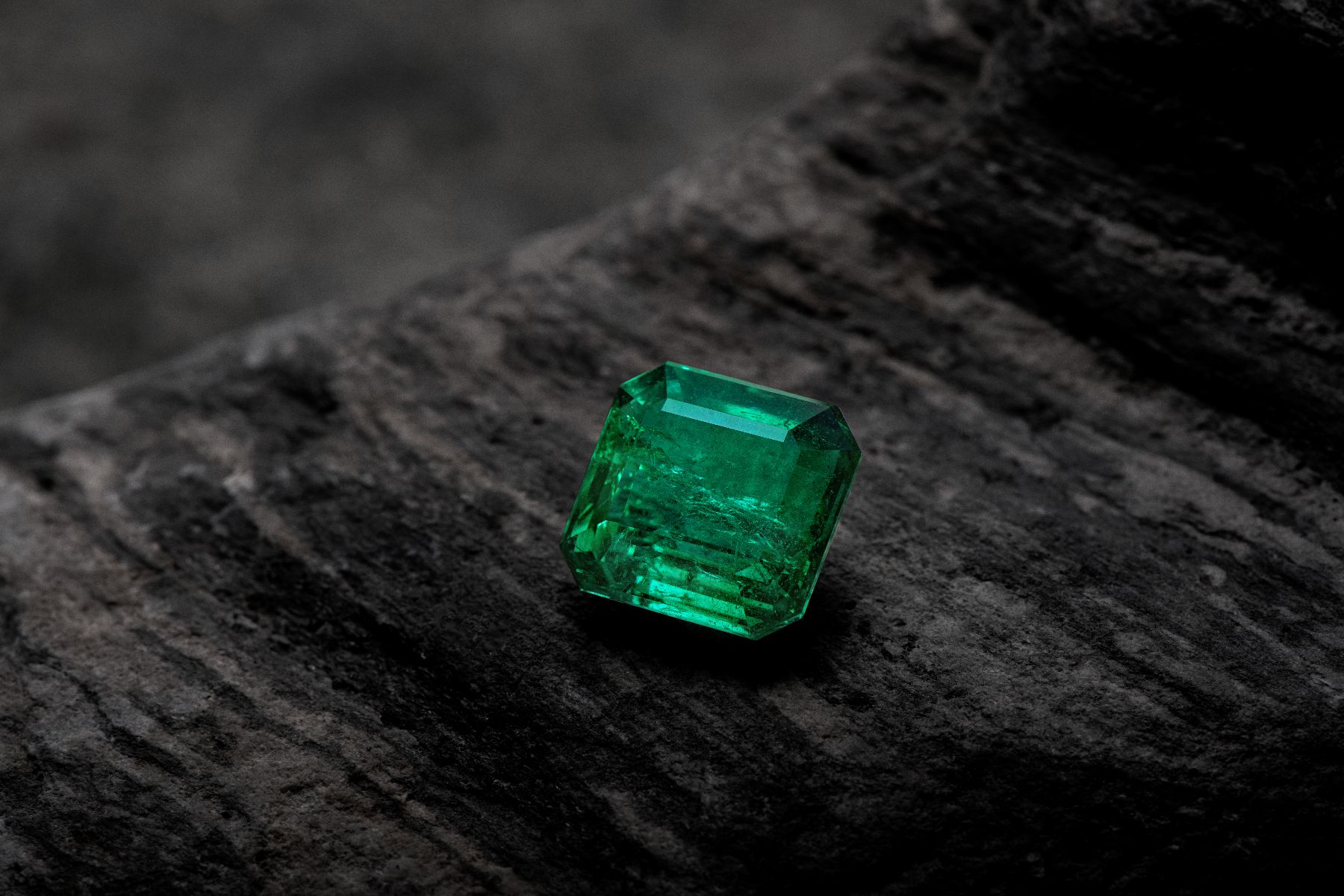
Colour — The Primary Criterion in Evaluating a Colombian Emerald
Colour takes precedence over clarity in Colombian emerald evaluation — a fundamental departure from diamonds. Almost every natural emerald carries inclusions; that is normal for this gemstone. What drives collector value is colour depth, saturation, and purity.
Hue
Hue describes the depth of colour on a spectrum from light green to dark green. Top-grade Colombian emeralds occupy the medium-dark to dark range. Stones that read too light lack the saturation density that distinguishes fine material; stones that shade too dark lose transparency and optical life. Muzo material tends to sit in the medium-dark range — the zone the trade has long recognised as the point where saturation and transparency remain in productive tension.
Saturation
Saturation measures colour intensity — how vivid and full the green reads. High saturation produces the quality most associated with Colombian emeralds at their finest: a green that reads as coming from within the stone, pure and self-contained. Low saturation produces colour that appears dull, greyish, or flat under observation. GRS, Gübelin, and SSEF each use distinct descriptive language in their reports to characterise saturation; within GRS terminology, "vivid green" denotes saturation at the uppermost range. It is worth clarifying the relationship between this descriptor and the GRS Muzo Green Appendix, which is addressed in the certification section below: vivid green is a colour description recorded in the main report body; Muzo Green is a separate, additional designation issued as an appendix under stricter qualifying conditions. All stones that receive the Muzo Green Appendix are vivid green, but not all vivid green stones qualify for the Appendix.
Colour Purity
Colour purity refers to the absence of secondary modifying tones. The most valued Colombian emeralds present an unmodified green — no yellow drift, no blue cast, no grey contamination. In commercially graded material, grey and yellow secondary tones are common and measurably reduce both the visual quality and the market position of the stone. When evaluating colour in person, natural daylight viewed face-up gives the most accurate reading. Strong artificial light — particularly directional or warm-toned sources — can suppress grey modifiers and misrepresent colour purity. Evaluating under multiple light conditions is standard practice.
Cut — How Shape Affects Value and Rarity in Colombian Emeralds
Cut decisions in Colombian emeralds balance structural protection, colour optimisation, and weight retention. Natural fissures — Jardin — mean the cutter must assess internal structure and fracture risk before committing to any shape.
The Emerald Cut
The rectangular step cut was developed specifically for this gemstone. Parallel facet planes distribute stress evenly, reducing fracture risk along natural fissures while preserving rough weight. The broad table presents colour directly face-up — stable, unscattered. It remains the dominant choice for top-grade Colombian material.
Other Faceted Shapes
Oval, cushion, and pear shapes require higher technical precision and appear at lower frequency. Round brilliants are the rarest — the weight loss and transparency requirements make them viable only on exceptional rough. When encountered in fine Colombian material, non-standard shapes carry a premium reflecting both cutting risk and finished rarity.
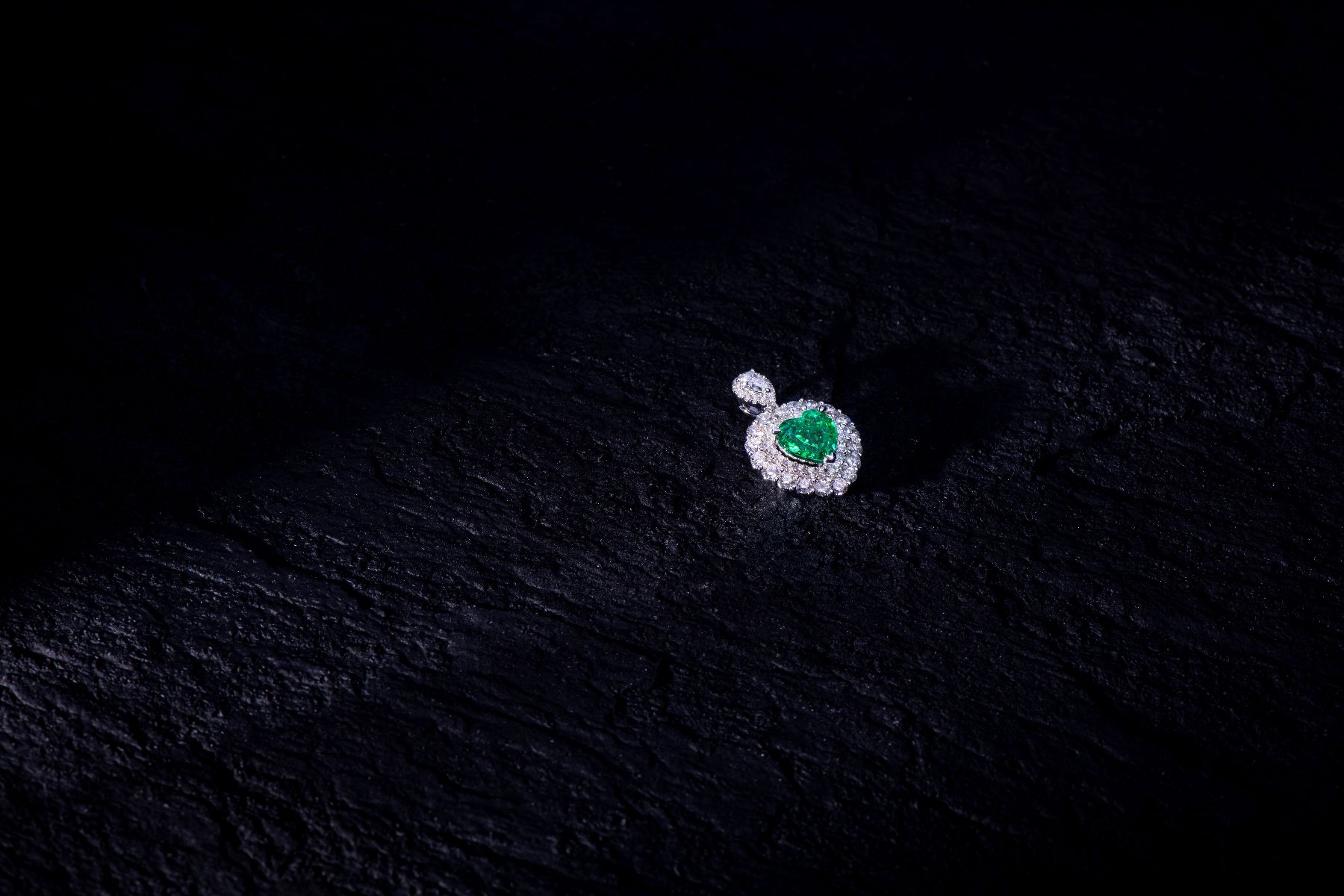
Heart Shape — Why It Is Almost Absent from Top-Grade Colombian Emeralds
heart outline concentrates mechanical stress at two vulnerable points: the cleft at the crown and the pointed culet at the base. Combined with Colombian emerald's natural fissures and basal cleavage, the margin for error is extremely narrow — a fracture at either point means loss of the entire rough. Most cutters choose conservative shapes when working with fine material. Heart-shaped Colombian emeralds of documented collector grade are among the least frequently encountered forms in the market.
Laboratory Reports — GRS, Gübelin, SSEF and the Muzo Green Standard
For high-value Colombian emeralds, laboratory documentation confirms origin, natural status, and treatment level. Three institutions are primary: GRS (Gem Research Swisslab), the most widely recognised in Asian markets, with a proprietary colour designation framework for Colombian emeralds; Gübelin Gem Lab, a benchmark authority for origin determination particularly respected in European institutional contexts; and SSEF (Swiss Gemmological Institute), which issues independent reports grounded in scientific methodology. All three are accepted at the major international auction houses.
The GRS Muzo Green Appendix
GRS introduced the Muzo Green standard at the First International Emerald Symposium in Bogotá in October 2015 — the same year it first appeared in auction catalogues. The designation is issued as an appendix to the main report, signed by GRS Director Dr. A. Peretti, confirming the stone's colour is "reminiscent in hue of the varieties displaying the legendary colors found in the world renowned Muzo mines." Two conditions must be met simultaneously: colour saturation and hue must reach the defined threshold, and clarity enhancement must fall within the permitted range. The Appendix is a colour filter applied above origin determination — not an extension of it.
Clarity Enhancement — The Factor That Most Directly Defines Market Position
Almost all natural emeralds have surface-reaching fissures. Filling them with cedarwood oil or synthetic resin to reduce light scattering is a centuries-old trade practice that does not alter natural identity. What it does affect is how much of a stone's colour and transparency derives from its geological structure versus post-cutting intervention.
GRS, Gübelin, and SSEF use a five-tier disclosure system: No oil (no filler detected by Raman spectroscopy and FTIR), Insignificant (lowest detectable presence), Minor, Moderate, and Significant. Most commercial Colombian emeralds fall in the Minor to Moderate range. No oil and Insignificant stones — where visual performance is largely self-contained — consistently command two to four times the per-carat value of equivalent Minor oil material. Auction observations from late 2024 showed increased unsold lots among Colombian emeralds where treatment levels or transparency did not meet buyer expectations. Colombian origin alone no longer functions as a reliable indicator of saleability at the upper end of the market.
Jardin — The Natural Characteristic of Colombian Emeralds
Almost every natural emerald carries inclusions — called Jardin, French for garden, describing their organic, varied appearance under magnification. Jardin is not a flaw; it is evidence of natural origin. Synthetic emeralds do not carry it. The relevant evaluation question is not whether Jardin is present but whether it compromises transparency. Inclusions that are evenly distributed and do not interrupt optical continuity are standard in fine Colombian material. Inclusions that visibly reduce clarity in the central viewing zone should be reflected in valuation.
Auction Market Performance
The secondary market for Colombian emeralds provides the clearest external validation of how condition, origin documentation, and treatment level interact to produce price. The pattern across major sales is consistent: the highest per-carat realisations belong to stones where Colombian provenance and low or no clarity enhancement are confirmed by independent laboratory reports.
In June 2017, the 18.04-carat Rockefeller Emerald — an untreated Colombian emerald with American Gemological Laboratories documentation — sold at Christie's New York for USD 5.5 million, establishing a world auction record for emeralds at USD 304,878 per carat. The previous record, also held by Christie's, was set by a 23.46-carat Colombian emerald from the collection of Elizabeth Taylor, which achieved USD 281,329 per carat. In May 2019, Christie's Hong Kong sold a matched pair of Colombian no-enhancement emeralds totalling 46.52 carats — certified by SSEF and AGL — for USD 4.4 million, the highest price achieved by any emerald at auction that year.
Sotheby's collector guidance published in May 2026 notes that Colombian emeralds above three carats combining vivid colour, low treatment levels, and strong transparency are "exceptionally rare" — a characterisation grounded in supply reality. As carat weight increases, the likelihood of all three conditions being present simultaneously decreases substantially. This scarcity dynamic accounts for the exponential per-carat premiums recorded at auction for large Colombian stones of documented quality.
What to Confirm Before Acquiring a Colombian Emerald
Colour takes priority over clarity, and colour and treatment level are interdependent. A stone that reads vivid green at Insignificant or No oil enhancement is demonstrating colour that belongs to the stone's own geological structure — not to post-cutting intervention.
JUSTLEE's reference framework for evaluating Colombian emeralds:
- Origin documentation: A report from GRS, Gübelin, or SSEF confirming Colombian origin is the minimum standard. Provenance stated verbally, without independent laboratory confirmation, is not verifiable.
- Colour: GRS "vivid green" in the main report body indicates saturation at the upper range. The GRS Muzo Green Appendix confirms that the colour meets a stricter, specifically defined threshold and that the enhancement level is consistent with that designation. The two are related but not equivalent.
- Enhancement level: Insignificant or No oil is JUSTLEE's reference baseline for collector-grade Colombian emeralds. Stones at Minor and above require careful assessment of how much the enhancement contributes to the visual result.
- Transparency: Jardin is expected and normal. The evaluation standard is whether inclusions interrupt the stone's transparency — not whether they are present.
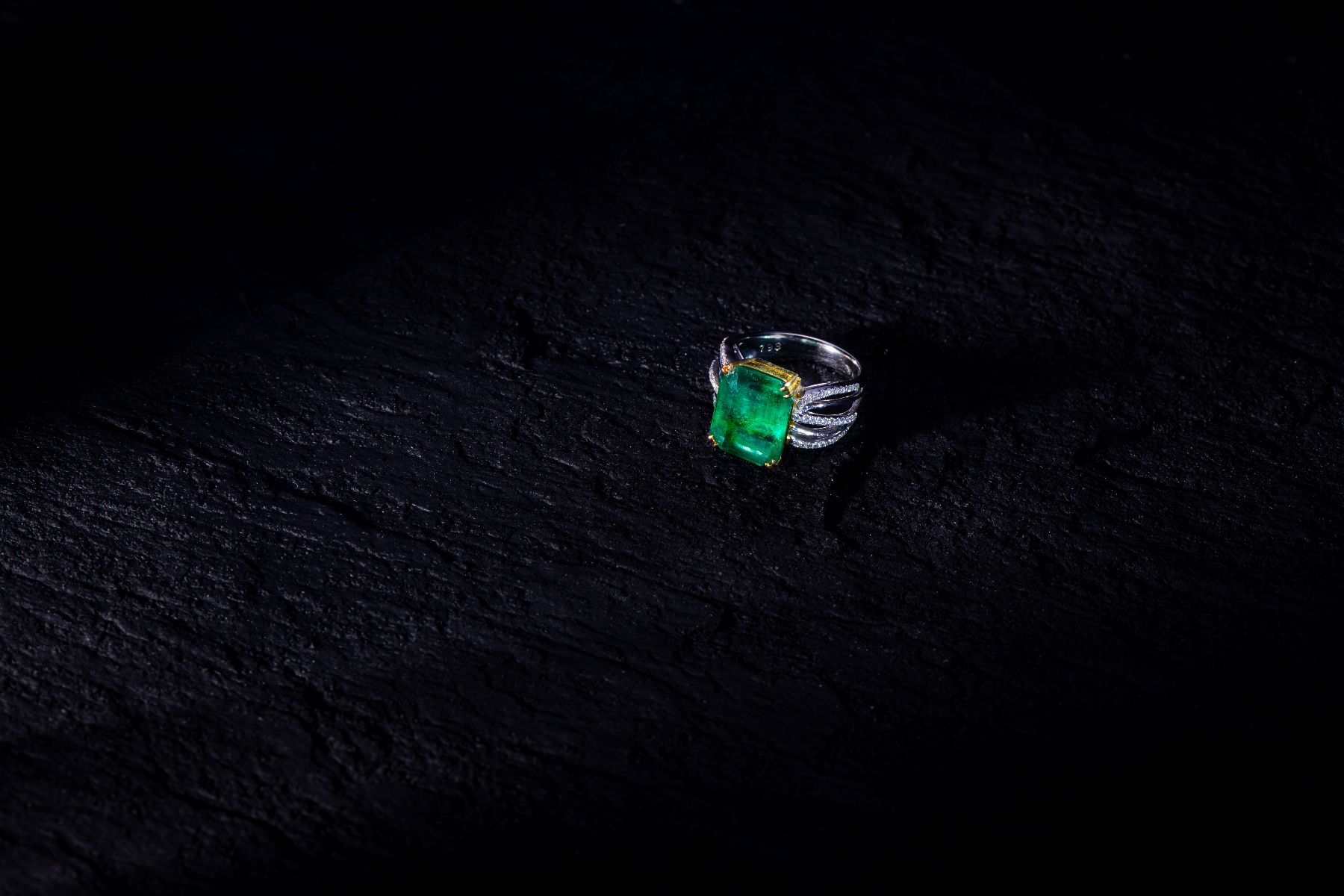
- Cut: Emerald cut is the market standard. Heart, pear, and other non-standard shapes are significantly rarer at collector grade and, where all other conditions are equivalent, introduce an additional dimension of scarcity.
- Laboratory report: For any significant acquisition, a current report from GRS, Gübelin, or SSEF is a non-negotiable document. These reports are the basis on which origin, treatment, and natural status can be independently verified.

Over fifty years of curation, JUSTLEE has never treated Colombian origin as a sufficient condition on its own. The name is well-established; the stones that merit serious consideration are not. Vivid green at Insignificant enhancement, documented by a laboratory whose standards can be independently verified, cut in a shape that demanded both structural courage and technical precision — these conditions converging in a single stone is what fifty years of selection has taught us to look for, and what continues to define the stones we choose to carry.
Click here to check more: JUSTLEE Curated Emerald
This article was prepared by the JUSTLEE advisory team. Sources include GRS certification standards and Muzo Green policy documentation (2017), Sotheby's "Colombian Emeralds: A Detailed Guide for Collectors and Enthusiasts" (May 2026), Christie's auction records, and Zwaan, J.C. et al., “Emeralds from the Kafubu Area, Zambia,” Gems & Gemology, 2005, Vol. 41, No. 2, pp. 116–148.GRS Muzo Green colour standard and policy | Sotheby's Colombian Emerald Guide | Christie's auction results
FAQ
Q: What is GRS Muzo Green, and how does it differ from standard Colombian origin certification?
A: GRS introduced the Muzo Green standard in 2015 as a colour designation for Colombian emeralds reaching a defined saturation and hue threshold. It is issued as an appendix signed by GRS Director Dr. A. Peretti. Colombian origin is a prerequisite, but the designation is not automatic — colour saturation, hue, and enhancement level must all qualify simultaneously. It is a colour filter applied above origin determination, not an extension of it.
Q: Why are Colombian emeralds more expensive than emeralds from other origins?
A: Colombia's black shale geological formation produces emeralds with high chromium concentration — the element responsible for saturated, unmodified green. Zambian emeralds are also chromium-coloured but carry markedly higher iron, which suppresses red fluorescence and pushes the colour bluer and deeper; Brazilian material lacks the chromium density of top Colombian rough. At equivalent treatment levels, Colombian emeralds command a 30 to 50 percent per-carat premium over Zambian or Brazilian stones. At the top of the quality range, that differential is wider.
Q: What is clarity enhancement in emeralds, and what is the difference between No oil and Insignificant?
A: Oil treatment introduces cedarwood oil or synthetic resin into natural surface fissures to improve apparent transparency. It does not change the stone's natural identity. No oil means instrumental analysis detected no filler material at all. Insignificant means the lowest detectable presence, with the stone's colour and transparency attributable primarily to its own structure. At equivalent quality, No oil and Insignificant stones typically price at two to four times the value of Minor oil material.
Q: How do I evaluate colour quality in a Colombian emerald?
A: Three dimensions: hue (depth — top-grade reads medium-dark to dark), saturation (intensity — fine stones present colour from within, not flat or grey), and colour purity (absence of secondary tones — no yellow drift, no grey contamination). Always evaluate face-up in natural daylight. Directional or warm artificial light suppresses grey secondary tones and gives a misleading reading.
Q: What is Jardin, and does it reduce the value of an emerald?
A: Jardin is the trade term for natural inclusions in emeralds — micro-fissures, fluid inclusions, and mineral fragments formed during crystal growth. Almost every natural emerald carries Jardin; synthetic emeralds do not. It is evidence of natural origin, not a defect. The evaluation question is whether inclusions compromise transparency. Evenly distributed inclusions that do not interrupt optical continuity are standard in fine Colombian material.
Q: How do Colombian and Zambian emeralds compare as collector acquisitions?
A: Colombian emeralds derive their colour primarily from chromium, producing saturated pure green that has served as the trade benchmark over centuries. Zambian emeralds are also chromium-coloured, but markedly higher iron suppresses the red fluorescence chromium generates, pushing the colour bluer and deeper; they typically carry fewer inclusions and can show higher transparency. Colombian material holds the deeper auction record and more established international market recognition. Zambian emeralds of documented quality offer a credible and often more accessible alternative. The choice depends on whether colour purity and provenance depth, or relative value within fine emeralds, is the primary consideration.
Q: Why is a heart-shaped Colombian emerald so rare?
A: Emerald rough carries natural fissures and basal cleavage planes that make heart cutting structurally hazardous. The cleft at the crown and the pointed culet concentrate mechanical stress at the two most fracture-prone positions. The margin for error is narrow; failure means loss of the entire rough. Most cutters working with top-grade material choose conservative outlines. Heart-shaped Colombian emeralds at collector grade are among the least frequently encountered forms in the market.
Q: Which laboratory report matters most when buying a Colombian emerald?
A: GRS, Gübelin, and SSEF are the three primary certification bodies, and all three are accepted at the major international auction houses. GRS carries the widest recognition in Asian markets and maintains the Muzo Green colour designation framework. Gübelin is regarded as a benchmark authority for origin determination. SSEF issues independent reports grounded in scientific methodology. For any significant acquisition, a current report from one of these three is a baseline requirement.
 Facebook
 Instagram
 Line
Line